
Many raise hogs for lean carcasses, but what sets heritage breeds apart is that they produce high-quality lard. They have marbled pork with fats.
While commercial hogs may produce pale, dry, and bland meat, heritage pork offers a range of textures and rich flavors.
If you want to raise old-fashioned, or heirloom hogs, here is my list of heritage breeds suitable for homesteads and small farms.
1. Berkshire Hog
As the name suggests, this hog breed hails from Berkshire County, England.
Berkshires are black, but you can see six white markings, with four white socks on the lower legs and one white spot on the snout and the tip of the tail.
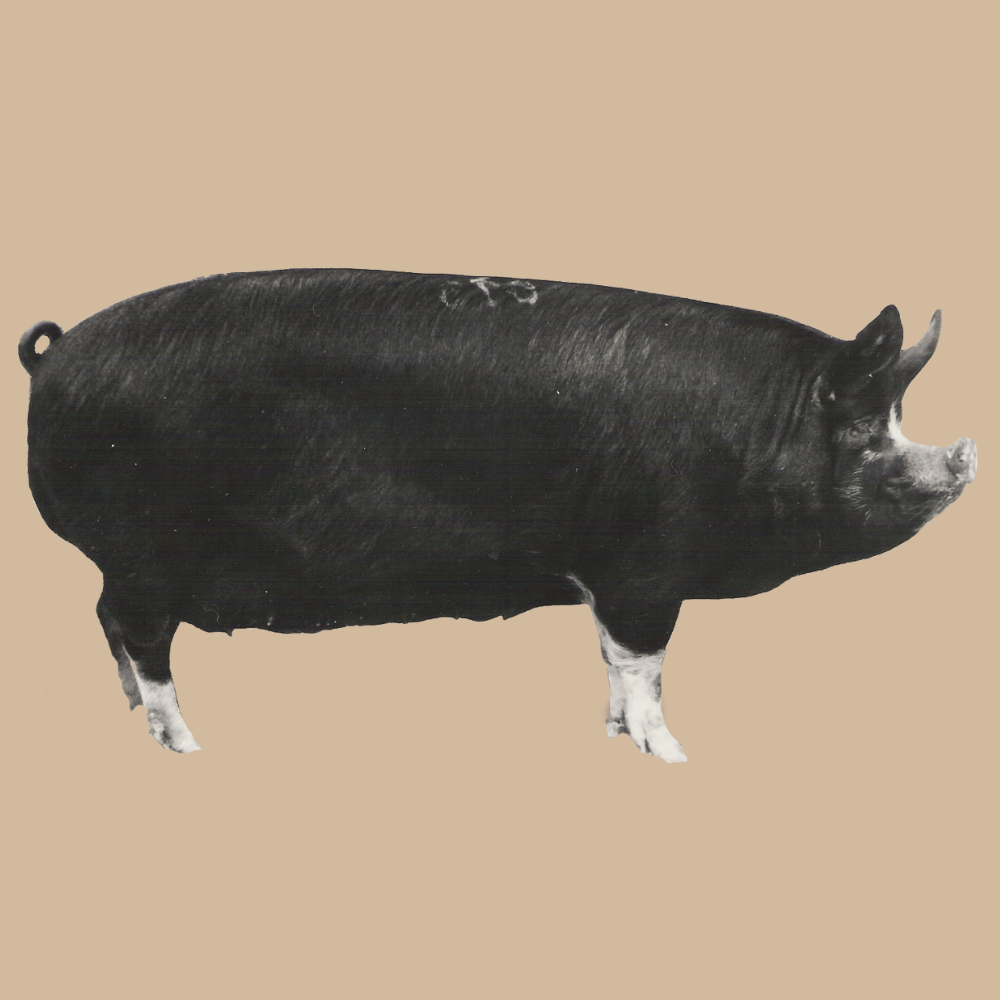
You can tell them by their long body with deep sides and a uniform arch of the back, and their muscular build and erect ears.
They are medium-sized hogs with mature boars weighing 600 lbs and sows weighing 500 lbs. So, expect their meat to be darker (pink-hued), tenderer, and juicier.
Thanks to their high fat content, they produce a really nice flavor and are known for their marbling.
These hogs are calm, friendly, and curious, so you won’t find it difficult to handle them.
The sows also make good mothers, which have lots of milk and bear 8-10 piglets every year.
2. Large Black Hog
As the name suggests, Large Black hogs are sold black and are large-framed animals. Their dark coloration helps protect these pigs from sunburn, allows them to pasture outdoors easily, and helps them tolerate a tropical climate.
They boast a head, straight face, with hanging or lop ears, which fall forward over their faces. So, their lop ears help protect their eyes from dirt and penetrating things while foraging and hoeing the pasture.
As their ears can block their sight, they mostly identify things through their sense of smell.
Native to Cornwall, Devon, and Somerset, this English breed is known for its finely textured, well-marbled, and medium-pink meat.
Their light shoulders, large hams, and good sides are great for bacon.
You can expect mature boars to weigh 700-800 lbs and mature sows to get 600-700 lbs, making great meat pigs.
Since they’re hardy, thrifty, and get most of their food from grazing and foraging, you won’t spend lots on their feed.
Besides, they have excellent maternal instinct, and you can see sows raising the large litters of weanling piglets outdoors.
And sows can be productive up to 9 years.
3. Tamworth Hog
If you want to raise a lean-type hog, the Tamworth can be perfect, which is a descendant of Northern Europe’s native pigs.
They are long, lean, athletic, and active.
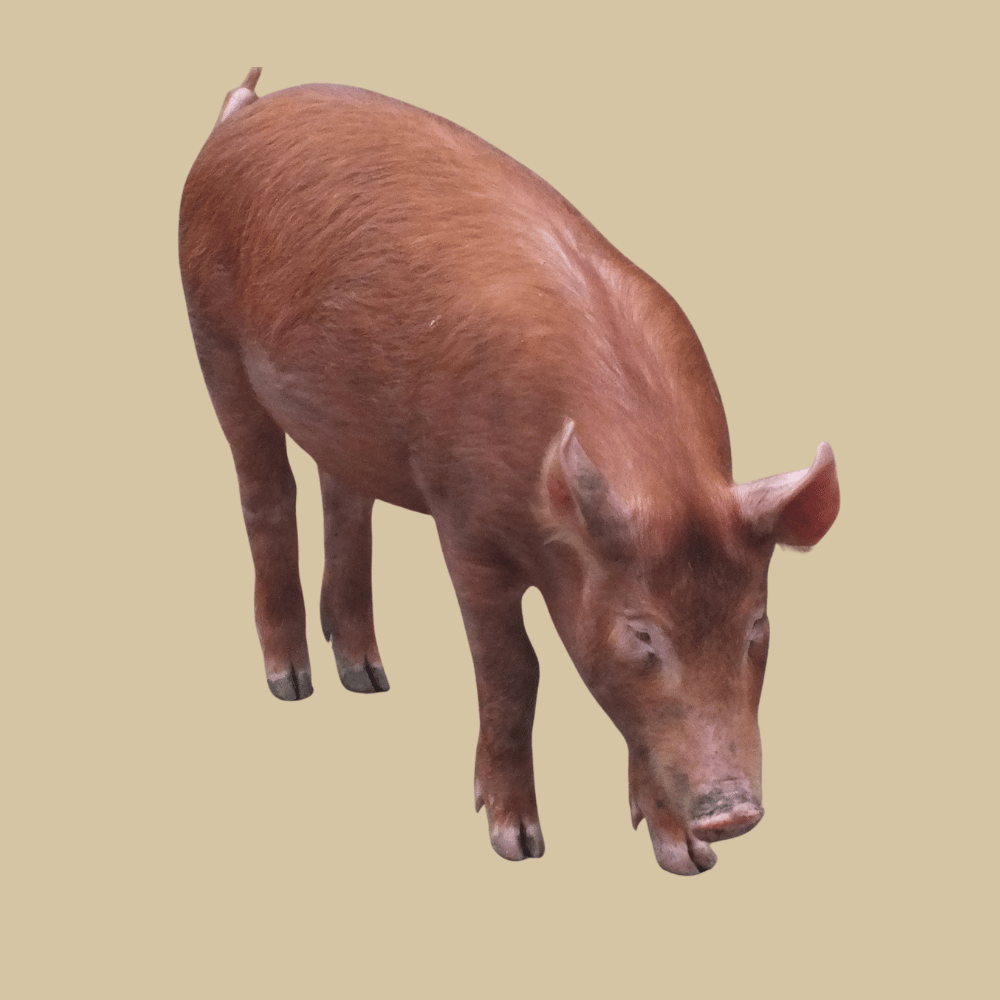
These hogs have long heads with noticeable snots, which helps them forage efficiently. Also, their long, strong legs make these animals excellent walkers, capable of covering considerable distances.
So, they are best for wooded or forested homesteads.
Tamworths are in ginger-red coats, which help them adapt to various climates, including mild-heat environments.
But they don’t perform well in the summer and molt under the sun. Their thick, coarse coat helps them survive cold weather instead.
You can also identify them by their long necks, deep sides, and narrow backs. Their ham frames are quite muscular and firm.
The mature boars range from 550 to 820 lbs, while full-grown sows weigh between 440 and 660 lbs.
They are called bacon hogs with lean and fine-grained meat. So, they live on low-energy food but grow slowly.
But these hogs produce a good carcass with a yield of up to 70%. I like their fine bones, which have more efficient meat-to-bone ratios for finished meat products.
Overall, Tamworth is a skilled forager, social, friendly, thrifty, and easy to care for breed.
4. Gloucestershire Old Spots
As the name suggests, this breed was developed in the Vale of Berkeley, Gloucestershire, England, during the 1800s.
Once they are called “cottage pig,” or “orchard pigs,” as they pasture on windfall fruits such as apples and grapes, and live on cider pressing, and on the agricultural wastes.
They are one of the oldest and largest hog breeds in England.
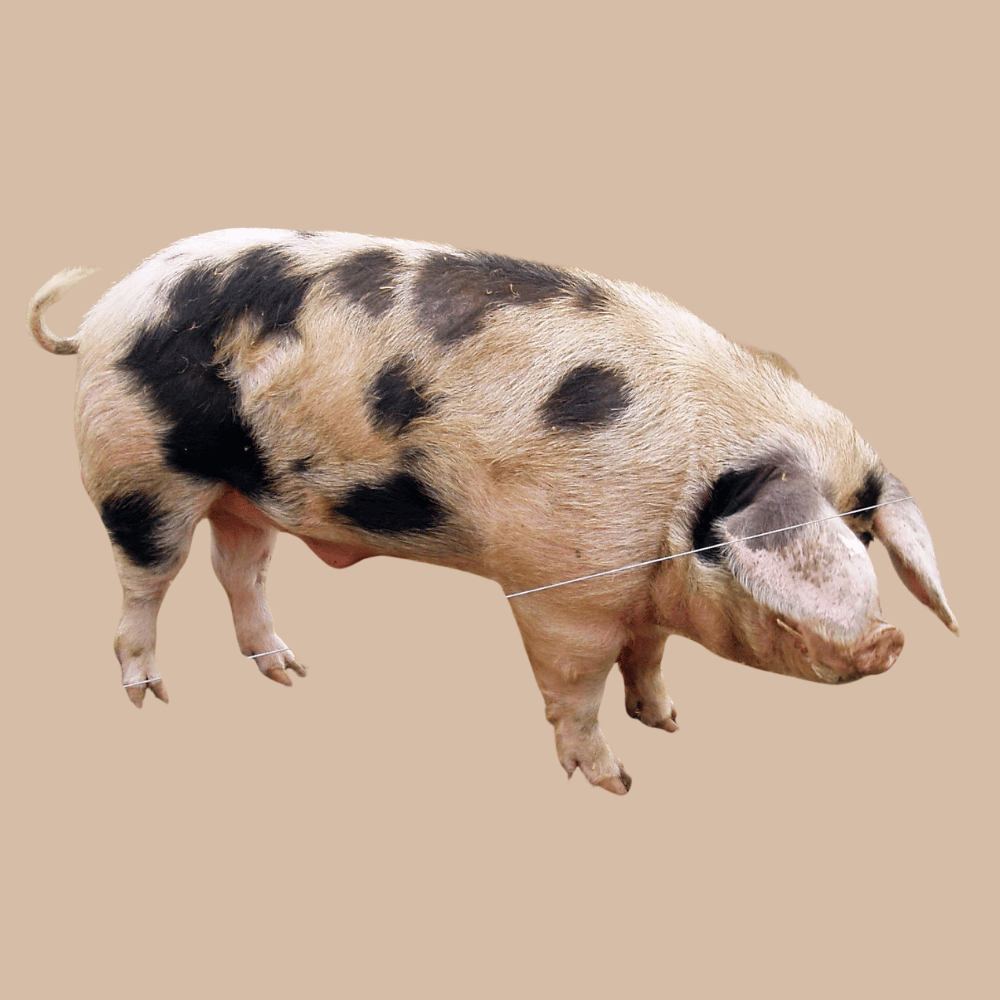
You can identify them by their white coats with some black spots and lop ears, which partially block the face and drop towards the nose.
Also, these big hogs have long heads with a slightly dished nose. They produce a long back with well-sprung ribs and a broad loin
While mature males weigh 600 lbs, sows reach 500 lbs. They are known as a lard breed that also makes excellent marbling.
They’re docile and easy-to-handle hogs. And sows produce large litters and lots of milk
5. Mulefoot Hog
This breed is named after solid, non-cloven hooves, which mimic a mule’s hooves.
Mulefoot hogs are black, but a few have white markings. You can tell them by their long snouts (similar to a wild boar’s), erect, floppy ears, and short, shiny hair.
Though these hogs look compact in appearance, they weigh between 400 and 600 lbs after maturity or 2 years.
They are disease-resistant, calm, docile, and hardy in cold climates.
Besides, sows make good mothers and give birth to 5 to 6 piglets on average and produce up to 12 babies per litter.
The hogs are known for producing ham and are well fed to achieve a desired weight before processing.
6. Red Wattle Hog
Red Wattles are large hogs with a fleshy wattle that grows either side of the neck. These wattles are a genetic characteristic that is passed down to offspring through crossbreeding. But they have no special function.
Native to North America, they also thrive in warm, southern climates.
They are in various colors, ranging from light blond to nearly black. A few boars grow tusks.
Their hair can be either short and straight or long and wavy. You can also tell them by their clean, lean head and jowl, with a slim, slightly curved nose and erect ears with drooping tips.
Besides, Red Wattles are large animals with a compact body and a slightly arched rump.
When fully grown, they stand about 4 feet tall and are 8 feet long. Normally, mature sows are at 600-800 lbs, and mature boars weigh 800-1000 lbs on average.
But a few can be as big as 1200 lbs. They reach their maturity after 3 years.
You can process them at 300-325 lbs and achieve a hanging weight of 220-245 lbs, with an excellent meat-to-fat ratio.
They produce well-marbled carcasses, and many claim their pork to be similar to beef in taste.
Anyway, Red Wattles are hardy, excellent foragers, and mild-tempered. Also, sows make good mothers and farrow 7-12 piglets per litter and produce high milk production for them.
7. Guinea Hog
Unlike rodents that have the same name, Guinea pig, Guinea hogs are real pork animals or a swine breed.
You can find two types of Guinea hogs in North America, including small-boned and large-boned hogs.
Also known as American Guinea hogs, these hogs have a black coat, a sturdy body, a curly tail, and erect ears.
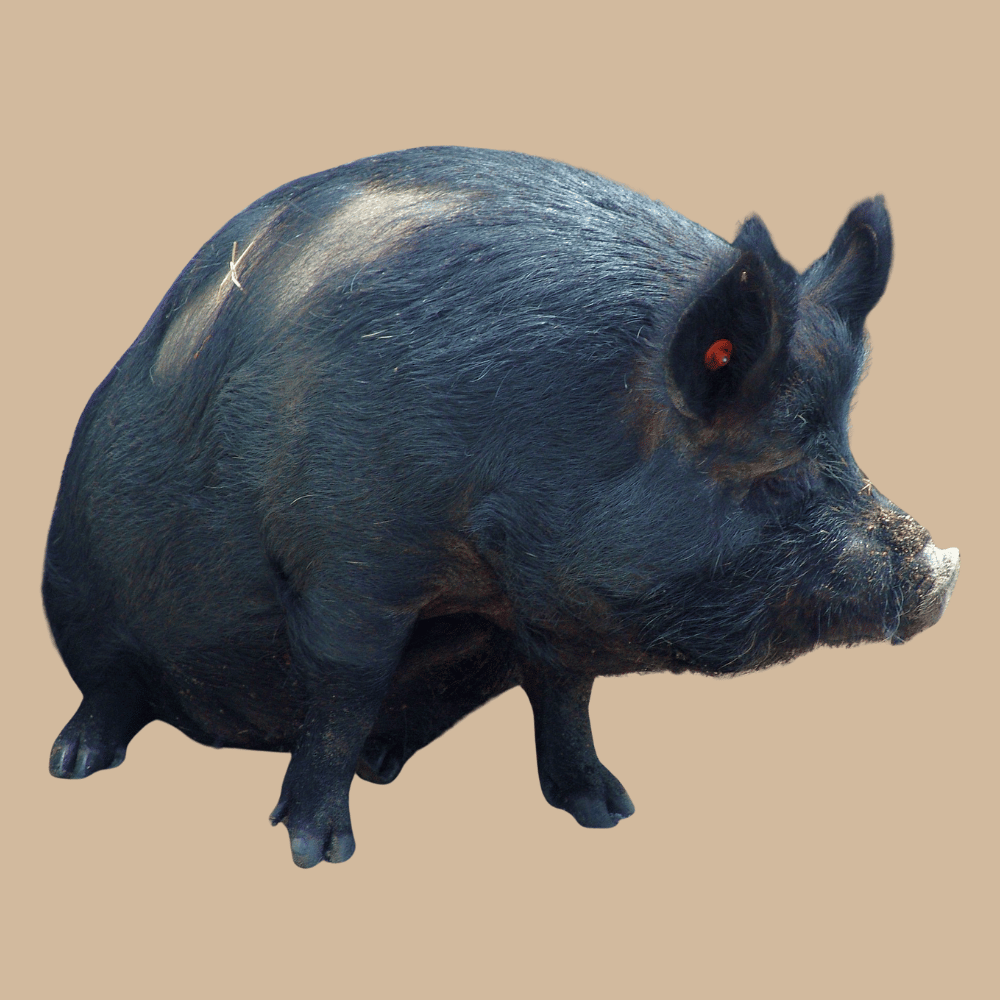
These hogs are small, with mature boars weighing 175-200 lbs and sows weighing 85-150 lbs. It’s a good option for family and individual stockmen who have limited freezer space.
Since they don’t produce a traditional market carcass, they aren’t really suitable for commercial farming.
But they can produce high-quality lard.
Anyway, they are well-suited for a small farm, backyard, or micro-homestead in the United States instead. Specifically, woods, orchards, and pastured land are the best settings for them to forage for their own food.
So, you can raise them on lower input.
Guinea hogs mature early, as soon as they are three months old, but I recommend you wait for 8-12 months for breeding. They can breed twice a year, and sows give birth to 6-10 piglets per litter.
Final Thoughts
If you like lean meat and want some marbled pork, I recommend raising Hampshire, Yorkshire, Spotted, Chester White, and Poland China hogs.
Besides, Berkshire, Gloucestershire Old Spots, Large Black, and lard-breed hogs can produce well-marbled, juicy pork.
Also, choose pastured big breeds to experience rich taste and flavor.
Leave a Reply